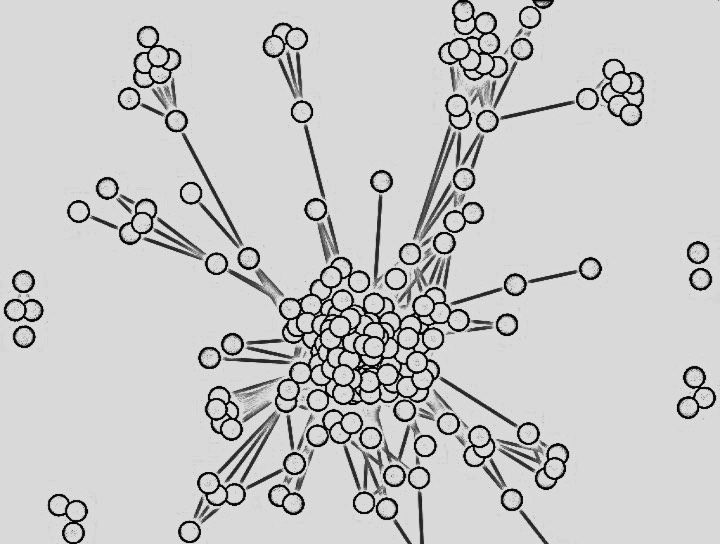


A new modeling framework developed by CBIOMES researchers, MCoM 1.0, reveals how metabolic exchanges shape the structure and function of marine microbial communities.
Reporting by Helen Hill for CBIOMES
The 2026 paper by Leonhard Lücken, Michael J. Follows, Jason G. Bragg, and Sinikka T. Lennartz introduces MCoM 1.0, a microbial community model designed to capture the intricate metabolic exchanges that structure marine microbial ecosystems. In doing so, the authors address a long‑standing challenge in ocean modeling: how to represent the dynamic, interdependent relationships between phototrophs and heterotrophs without oversimplifying the diversity and flexibility that define microbial life in the ocean.
At its core, MCoM 1.0 is built around the idea that microbial communities are best understood not as isolated functional groups but as networks of organisms linked by the flow of carbon, nutrients, and metabolic byproducts. Traditional ecosystem models often rely on fixed functional types—broad categories like “diatom,” “cyanobacterium,” or “heterotrophic bacteria”—each with predetermined traits. While useful for large‑scale simulations, these abstractions can obscure the fluidity of microbial interactions, especially the metabolic handoffs that allow communities to adapt to shifting environmental conditions. Lücken and colleagues propose a different approach: a scalable, modular framework that allows phototrophs and heterotrophs to interact through explicit metabolic exchanges, with community structure emerging from these interactions rather than being imposed from above.
In MCoM 1.0, phototrophs fix carbon and release a spectrum of organic compounds, while heterotrophs consume these compounds according to their metabolic capabilities. This setup allows the model to simulate a wide range of community configurations, from tightly coupled phototroph–heterotroph pairs to more diffuse networks in which multiple organisms share resources. The authors demonstrate how this flexibility enables the model to reproduce realistic patterns of microbial coexistence, competition, and succession. For example, when phototrophs release different mixes of dissolved organic matter, heterotrophs with complementary metabolic pathways can coexist by partitioning the available substrates. Conversely, when resources become scarce or homogeneous, competitive exclusion can occur, reshaping the community.
One of the strengths of MCoM 1.0 is its scalability. The framework can be applied to simple laboratory‑style systems with a handful of interacting organisms or expanded to represent the complexity of natural microbial assemblages. This scalability is particularly valuable for bridging the gap between controlled experiments and global biogeochemical models. By grounding community dynamics in mechanistic interactions, the model provides a pathway for incorporating microbial diversity into larger‑scale simulations without overwhelming them with unnecessary detail. It also offers a platform for testing hypotheses about how microbial communities respond to environmental change, such as shifts in nutrient supply, temperature, or light availability.
Publication:
Leonhard Lücken, Michael J. Follows, Jason G. Bragg, and Sinikka T. Lennartz (2026), The microbial community model MCoM 1.0: a scalable framework for modelling phototroph–heterotrophic interactions in diverse microbial communities, Geosci. Model Dev., doi: 10.5194/gmd-19-2461-2026